Epistles, Horace
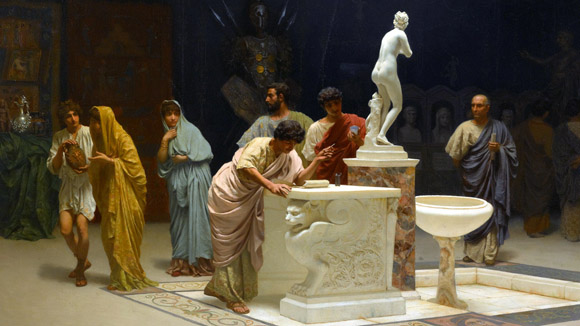
At Maecenas' Reception Room, Stefan Bakałowicz, 1890
He who puts off the hour to begin living rightly;
Is like the yokel who stands at the stream with a sigh:
“I can't get across. I'll wait here till it runs dry.”
Meanwhile, it flows, forever flows on and rolls by.
Horace's Epistles are collections (two of them, but almost always published together) of letters addressed to various people and composed in hexameter verse. They are full of useful moral maxims, but this is poetry, not carefully argued philosophy with a definite point of view. Nonetheless, the mature Horace of the Epistles is definitely reaching out beyond beauty, to get a hold on truth and goodness as well:
So now I lay aside my verses and all other toys. What is right and seemly is my study and pursuit, and to that am I wholly given.
Standing somewhere between Epicurus and the Stoics, Horace plucks some valuable fruits:
Look round and round the man you recommend,
For yours will be the shame should he offend.
A man has lost his weapons, has quitted his post with Virtue, who is ever busied and lost in making money.
All the same, and most endearingly, he knows his own limitations too:
That's me of course. Since I praise the safe and humble
When funds are lacking, resolute enough with what's mean:
But when something better and finer appears, the same
'I' declares that only you live wisely and well
Whose established wealth's revealed in smart villas.
Horace has been popular and a huge influence on Western culture since his own time, so of course there are many translations and editions to choose from. As Horace was a poet and the Epistles are in verse, you each have an important decision to make: read a translation that attempts to render his Latin into English verse, or choose instead a more literal translation that may have to dispense with the poetry. I have the Loeb edition, translated by Fairclough, so I'll read that one. But the first quote above is from Smith Palmer Bovie's very readable verse translation. Fairclough has it thus:
He who puts off the hour of right living is like the bumpkin waiting for the river to run out: yet on it glides, and on it will glide, rolling its flood forever.
Note that we have a little less than four weeks for this one, but don't worry, it isn't particularly long. For that reason it is almost always bound together with the Satires or other works of Horace. Ars Poetica is really the last of the Epistles, but it is usually treated as separate; go ahead and read it too if you'd like but it is somewhat less applicable to self-improvement, so we may not talk about it much.
We will meet at 7PM on Monday, April 27, at Vino's on Los Olas, and “drown care in wine” together.
 2026
2026 Subscribe with RSS
 Flickr
 Twitter
 Google +
 LinkedIn