Sun and Steel, Yukio Mishima
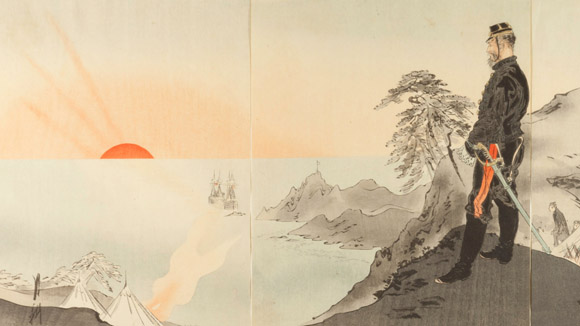
Ogata Gekko, Picture of Officers and Men Worshipping the Rising Sun While Encamped in the Mountains of Port Arthur
If my self was my dwelling, then my body resembled an orchard that surrounded it. I could either cultivate that orchard to its capacity or leave it for the weeds to run riot in. I was free to choose, but the freedom was not as obvious as it might seem. Many people, indeed, go so far as to refer to the orchards of their dwellings as "destiny".
One day, it occurred to me to set about cultivating my orchard for all I was worth.
Here's a summer read, a short palate cleanser before we dive back into Montaigne, and as a special treat, it's not even that old. 1968! Our youngest book yet. I'm bending our rules hard this time.
We old-school self-improvers put a lot of faith in the power of words, it's why we're here, after all, but maybe we don't believe in them quite as much as a young Yukio Mishima did. Here he describes his early development:
In the average person, I imagine, the body precedes language. In my case, words came first of all; then—belatedly, with every appearance of extreme reluctance, and already clothed in concepts—came the flesh. It was already, as goes without saying, sadly wasted by words.
And here his teenage romanticization of a twilight, bookish existence:
I loved my pit, my dusky room, the area of my desk with its piles of books! How I enjoyed introspection, shrouded myself in cogitation; with what rapture did I listen for the rustling of frail insects in the thickets of my nerves!
But something was missing. Recognizing his limitations, Mishima longed for a healthier body and healthier thinking. He took himself into the open air (the sun) and applied himself to lifting weights (the steel), in search of a more physical mode of existence, which he certainly found, becoming—in addition to Japan's most celebrated novelist—a bodybuilder, a martial artist, and a model. This search culminated in his attempted overthrow of the Japanese government and subsequent ritual suicide only two years after the publication of this book.
I trust you all to stop short of these final extremes.
Like all of Mishima's books, Sun and Steel is written in Japanese. As far as I know the only English translation available is the 1970 one by John Bester.
Please join us at our usual venue on July 27, at 7 PM, to compare notes, and perhaps biceps too. Until then I wish you good training!
 2026
2026 Subscribe with RSS
 Flickr
 Twitter
 Google +
 LinkedIn