Entries in Category O.S.S.I. Book Club

Essays of Michel de Montaigne, Book 1

Portrait of Michel de Montaigne, Augustin de Saint-Aubin, 1774

Thus, reader, myself am the matter of my book: there’s no reason thou shouldst employ thy leisure about so frivolous and vain a subject.

In 1570, Michel de Montaigne, then 37, retired from his law career. A year later, he began his real work. Sequestering himself in his study (literally a tower), he set about inventing, and even immediately perfecting, a new literary form: the essay.

The Complete Works of Epicurus

Photo by Batatolis Panagiotis

It is impossible to live pleasantly without living prudently, honourably, and justly and impossible to live prudently, honourably, and justly without living pleasantly.

Epicurus was a very prolific philosopher, authoring over 300 works. This month, we will read all of them.

All of the ones that have survived.

Had you going there, didn't I? As it happens, there's not that much left, so with very little effort, by the end of the month you will have read as much Epicurus as anyone alive.

Epistles, Horace

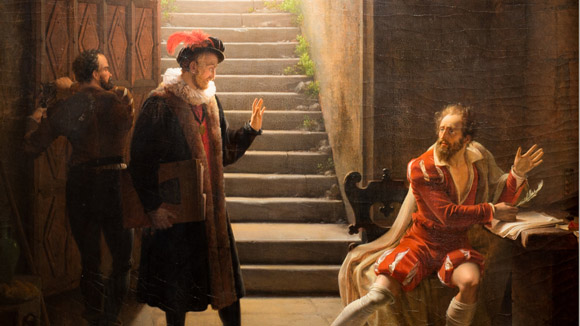
At Maecenas' Reception Room, Stefan Bakałowicz, 1890

He who puts off the hour to begin living rightly;
Is like the yokel who stands at the stream with a sigh:
“I can't get across. I'll wait here till it runs dry.”
Meanwhile, it flows, forever flows on and rolls by.

Horace's Epistles are collections (two of them, but almost always published together) of letters addressed to various people and composed in hexameter verse. They are full of useful moral maxims, but this is poetry, not carefully argued philosophy with a definite point of view. Nonetheless, the mature Horace of the Epistles is definitely reaching out beyond beauty, to get a hold on truth and goodness as well:

So now I lay aside my verses and all other toys. What is right and seemly is my study and pursuit, and to that am I wholly given.

Letters to a Young Poet, Rainer Maria Rilke

Portrait drawing of Rainer Maria Rilke, Leonid Pasternak, 1901

Do you remember how this life of yours longed in childhood to belong to the 'grown-ups'? I can see that it now longs to move on from them and is drawn to those who are greater yet. That is why it does not cease to be difficult, but also why it will not cease to grow.

It's been a while. Let's ease back into our reading with a short one, a miniature jewel: the poet Rainer Maria Rilke's ten letters written to Franz Xaver Kappus in the years 1903–1908 (Yes, that's very modern by our standards. We'll let it slide this time). Kappus, an unhappy officer cadet who dreamed of living the life of a poet instead, sent some of his verses to the already published and somewhat famous (although almost as young as himself) poet Rilke asking for criticism and advice. He didn't get criticism (“any critical intention is too remote from me”, says Rilke) but of advice he got plenty. And what advice it is!

On the Aesthetic Education of Man, Schiller

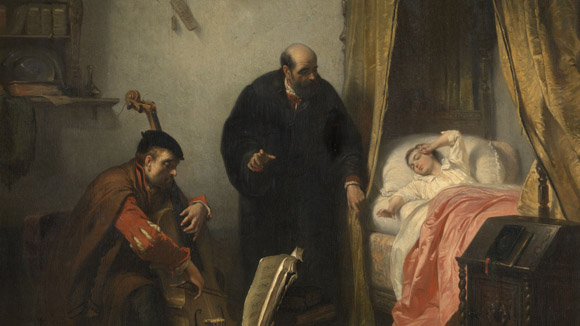
A Painter's Studio, Louis-Léopold Boilly, c. 1800

But how does the artist secure himself against the corruptions of his time, which everywhere encircle him? By disdaining its opinion. Let him look upwards to his own dignity and to Law, not downwards to fortune and to everyday needs.

It is common to say that philosophy is about three things: the true, the good, and the beautiful. We've sampled widely across philosophy, but most of our reading has been about the good, because we are looking for practical advice on how to live. Modern academic philosophy, by contrast, is mostly about the true, because you can endlessly turn out answers to “how do we know what we know?” and academics need jobs, after all.

Beauty, however, is the most neglected of the trio. Maybe because it's easy to dismiss as an unnecessary luxury, something we should give up for the sake of some other worthy goal. Maybe because of the slippery task of trying to define what it is and the subsequent escape into subjectivity. You've heard all that noise about the “eye of the beholder”, “that's YOUR opinion”, “one man's trash” and so forth.

But let's not give the bromides too much credit. One man that definitely didn't was the 18th century German Friedrich Schiller, who wrote On the Aesthetic Education of Man (sometimes rendered in English as Aesthetical Letters or several similar variations), a work that respects Beauty as at least equal to her sisters Truth and Goodness. Shocked by the descent of the French Revolution, which seemed to begin with high-minded ideals, into blood and madness, Schiller asks: how could this have been avoided? If political revolution doesn't work, what conditions are necessary to really produce human flourishing?

Archives: